Reading is so personal. Everyone chooses books for different reasons, likes certain books for different reasons, gravitates toward certain genres for different reasons…your bookish profile is like a fingerprint. It’s yours, and it’s completely unique.
So, when it comes to finding book recommendations, what are your go-to methods?
To find recommendations, I used to head to Google fairly often and search for “books like [book I just loved]” or “best memoirs published in 2024,” for example.
But if you do that now? Let’s take a look.
How AI is Taking Over Book Recommendations
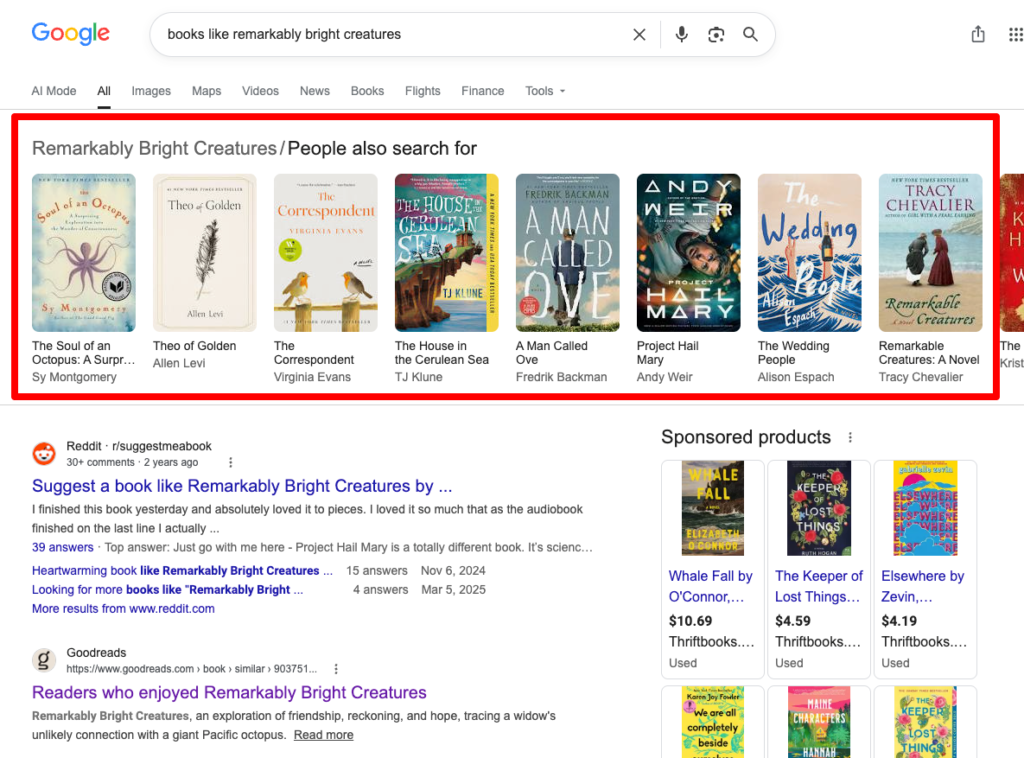
First of all, when you search for book recommendations on Google, you’ll get a box of books to scroll through at the top of the page. Please note that these are NOT book recommendations! These are simply books that people who’ve searched for your book in question have also looked for. They’re not actually related to your book in any other way.
Also in the list of results, you’ll most likely see an AI Overview box like this one:
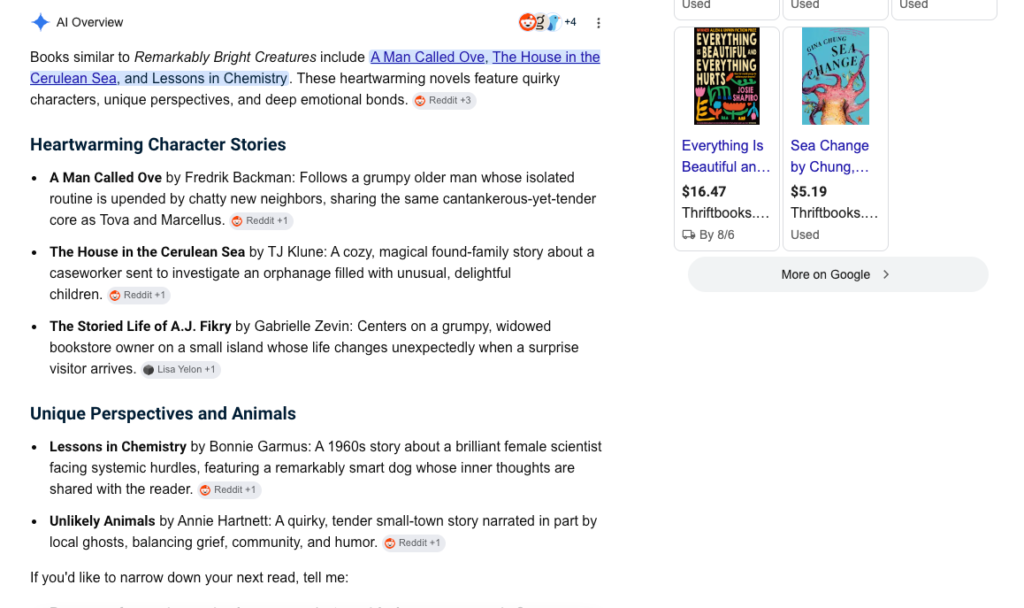
Can AI sometimes help you find a book you’d enjoy? Sure (and extra props to this one because it recommends one of my faves, Unlikely Animals). But did you know that this AI Overview only knows which books to recommend because it has stolen this advice from real people and is just repackaging it as its own?
For the love of books and all of us who post about books on the internet, please skip this section. Click into a real result where you can read what the human behind the recommendation has to say.
And the “Sponsored Products” boxes on the side? I honestly have no idea how the algorithm chooses which books to show there. But those aren’t real recommendations either.
Also at the top of the results, you’ll almost always find Reddit and Goodreads.
The Goodreads lists are, in my opinion, kind of lame. They’re only ranking there because Goodreads is, you know, Goodreads. The particular Goodreads list in my results for “books like Remarkably Bright Creatures” doesn’t say anything about who curated it, why the books are recommended, how they’re related…nothing. It’s just a list.
Reddit is a legitimate source of book recommendations from real people, so you’ll find it in my list below, but make sure to check out my caveats.
Let’s get on with how to find recommendations that really work for you!
How to Find the Best Book Recommendations + Build Your Book Recommendation Engine
Here are my favorite ways to find non-AI book recommendations:
1. Use Google + Set Your Preferences
To find spot-on book recommendations, scroll the Google results until you see a list that looks like it was curated and written by a real person.
In my example, these two results in particular caught my eye:
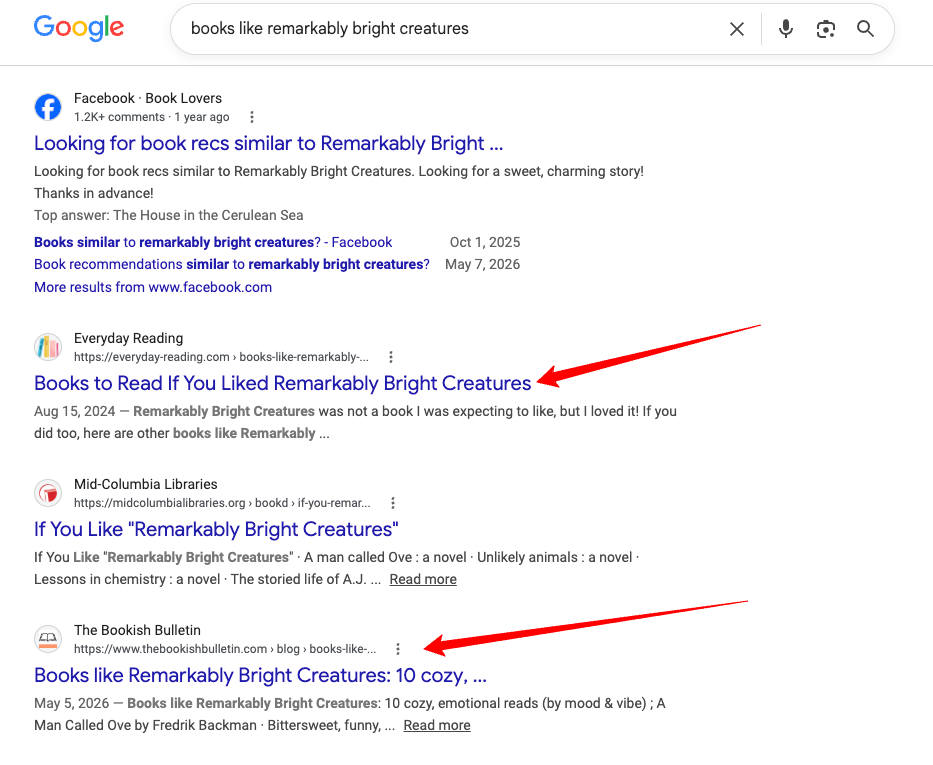
Click into the result, spend some time looking at the list, and decide if any of the recommendations look like they’re up your alley.
If they do, take things one step further. Go ahead and click on the website’s homepage. Look at who writes the content. Look at their other lists and reviews. If you’re really jiving with it, sign up for their newsletter, if they have one! And then, set them as a preferred source in Google so that when you’re looking for reviews or recommendations in the future, Google will serve you results from them first.
Yep, you can tell Google that you like that site and actually curate your search results! Most people don’t know this, but it’s my ultimate hack for book lovers.
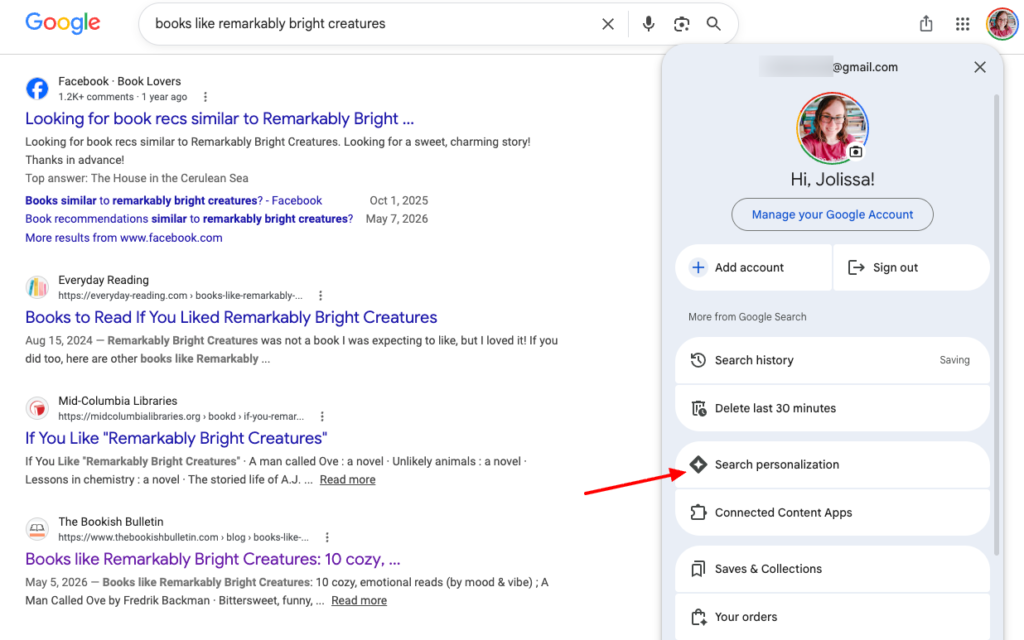
Let’s say you’ve explored thebookishbulletin.com, love the content, and want to see content from there listed at the top of your results in the future. To do that, click on your profile photo in the top right corner and choose “Search personalization:”
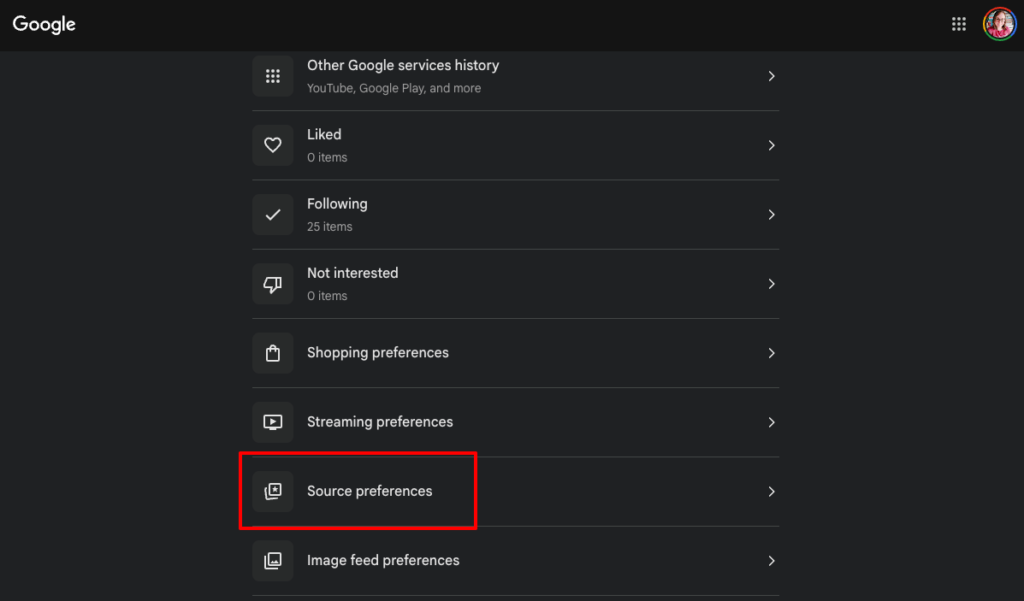
Then, scroll down until you find “Source preferences” and click on it:
In the box, start typing in “thebookishbulletin” to get the website to come up. When you see it, check the box next to it:
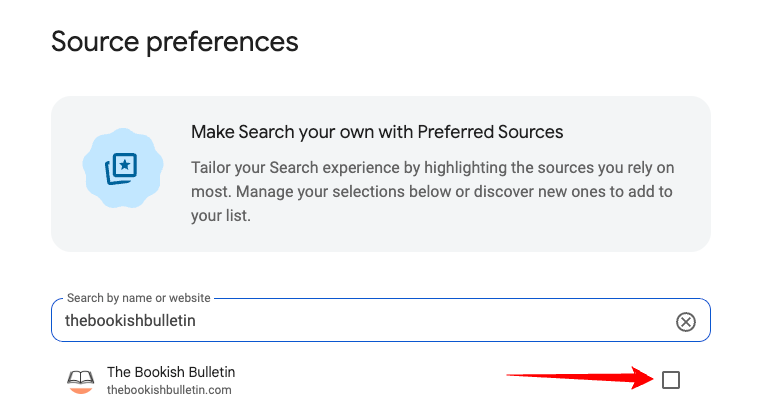
That’s it! Now, if there’s content on thebookishbulletin.com that matches a search you run in the future, Google will serve you that result at the top.
Please use this feature liberally! Add all the book bloggers you come across and love the content from. Help us steal back some of our lost traffic from Google’s AI Overviews!
Want to add Literary Quicksand as a preferred source? I’d love that so very much, thank you!
Click this link to add LQ to your preferred sources.
2. Follow Bookish Publications/Newsletters
Beyond book blogs, I love getting recommendations from publications and newsletters. This will be super unique to you and your interests, but if you can find the ones that resonate with you, you’ll be in a good spot.
For example, at my public library, new issues of the Booklist Reader (via Libby) and BookPage (free print copy) appear every month. I’ve grown my TBR way too much by reading these magazines! Highly recommend you check your local library for them.
Other publications and newsletters you might look for include:
- A books section in a newspaper
- Particular publishers you like
- Local bookstores often curate lists
- Literary Hub’s Book Marks
- Bookshop.org’s bookseller recommendations, most anticipated books, and celebrity book club picks
- Celebrity book clubs like Read with Jenna, Reese’s Book Club, and Belletrist, to name a few
3. Curate Your Social Media Feeds
This one’s pretty self-explanatory: follow social media content creators with similar bookish tastes. You will find bookish people on pretty much every social media app! TikTok’s got the booktok community, Instagram has the bookstagrammers, Threads has BookThreads, YouTube has booktubers…wherever you go, there they are.
The drawback with social media is, of course, that it’s social media. It will suck you in. I used to be a bookstagrammer for this blog but quit when Reels became such a big deal, and since then, just haven’t used social media very much at all.
If social media is your thing, though, I can’t imagine a better use for it than book discovery and book nerd friendship. Right??
4. IRL Book Clubs
Every time I meet up with my IRL book club, I come back with at least one book added to my TBR list. We talk about the book we read for the month, but we also talk about what else we’ve been reading. I know some of the members of my book club have similar taste to mine, so they give awesome recommendations sometimes!
I’ll admit, though, that IRL book clubs can be hard to find and hard to make time for. A few places to look:
- Ask your local Buy Nothing group
- See if there’s a chapter of The Gloss in your area (this is the book club I’m in)
- Check on meetup.com
- Check your local library
- Ask in a local Facebook group
- Check your local indie bookstore
5. Reddit
Although Reddit qualifies as social media, I’m making a separate space here to talk about it because…I have thoughts.
I’m sure you’ve noticed recently that Google has really been prioritizing Reddit in search results. It makes sense as Google tries to make sure it’s showing content from real people (or so it says, as it scrapes real peoples’ content and regurgitates it with AI).
Whatever, that’s fine, it’s cool that Google is doing *something* to move away from AI slop. But the problem with clicking into Reddit results for book recommendations is often just the sheer number of them.
For example, here’s the result for our Remarkably Bright Creatures query:
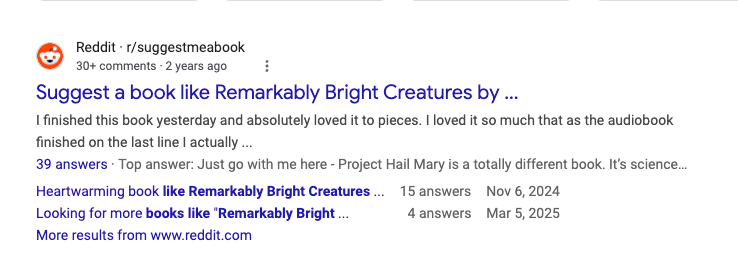
The top thread has 39 answers, and many people in there probably recommended multiple books. The next one has 15 answers, and the one after that has 4.
Friend, you’re in for a scroll.
Of course, there’s nothing wrong with going down a literary rabbit hole and looking up a bunch of book recommendations from the thread.
But also? You don’t know any of these people. You don’t know their tastes. You don’t know if they’re really into stories that get all tied up with a bow at the end, while you like your books on the more real side. These people are strangers. Book-loving strangers are the best kind of strangers, but still…it’s hard to trust their recommendations when they’re nameless, faceless internet people.
I’m not saying that there aren’t going to be really good recommendations in the thread, but the scrolling and weeding you’ll have to do might be more than you bargained for.
Another option on Reddit is to create your own posts in /suggestmeabook or /booksuggestions. I’ve done this in the past with good results, but I’ve also had posts get almost no replies and one that got far too many (200+).
So I guess the moral of my story is Reddit at your own time-suck risk.
6. Bookish Podcasts
I’m a huge podcast fan, so I can’t forget bookish podcasts! The only problem is, it’s so easy to make a podcast these days that bookish podcasts are a dime a dozen.
I’ll link to some that I’ve listened to and enjoyed in the past, but I’m sure I’m missing some really good ones. At any rate, find one where the host(s) has a similar taste in books to your own!
- What Should I Read Next?
- The Book Review (The New York Times)
- If Books Could Kill
- Book Riot – The Podcast
- FictionMatters
- Sarah’s Bookshelves Live
- NPR’s Book of the Day
How do you find book recommendations?
Now you know all the methods I use to find my next reads. What are yours?? Please leave a comment and let me know!
And while you’re here, make sure to check out some of LQ’s book lists 🙂
FAQ
Are Google AI Overviews good for book recommendations?
Sometimes, but proceed with caution — AI Overviews often repackage advice from real book bloggers and readers without attribution. If a book sounds interesting, click through to a real source instead of trusting the summary alone.
How do I stop getting AI-generated book recommendations from Google?
You can train Google to prioritize bookish sources you trust: go to Search Settings > Search personalization > Source preferences, and add the book blogs, publications, or writers whose taste matches yours. Google will then list their content first.
Is Reddit reliable for book recommendations?
It can be, but it’s a mixed bag. You’re getting opinions from strangers whose reading taste you don’t actually know, and threads can have dozens of replies to sift through. It’s worth the scroll occasionally, just don’t treat it as curated.
How can I find book bloggers or reviewers who match my taste?
Search for “books like [title you loved],” skip the AI Overview box, and click into results written by an identifiable person. Check their homepage, browse their other reviews, and if their taste lines up with yours, follow them or set them as a preferred Google source.
Why are AI-generated book recommendations a problem?
They’re typically built by scraping and repackaging recommendations from real readers and bloggers, without sending traffic or credit back to the people who did the actual reading and writing.

More About Me
- What We Read in September 2026 - October 13, 2026
- Reading While Neurodivergent: The Sensory Magic of Books - October 2, 2026
- What We Read in August 2026 - September 9, 2026
1 comment
I liked the idea of finding book recommendations without relying entirely on AI. With so many books available, it can be helpful to explore different ways of discovering what to read, especially when personal interests and recommendations from real readers can play an important role. https://solihullpublishing.com/