
Book Summary
Don and Mimi Galvin seemed to be living the American dream. After World War II, Don’s work with the Air Force brought them to Colorado, where their twelve children perfectly spanned the baby boom: the oldest born in 1945, the youngest in 1965. In those years, there was an established script for a family like the Galvins–aspiration, hard work, upward mobility, domestic harmony–and they worked hard to play their parts. But behind the scenes was a different story: psychological breakdown, sudden shocking violence, hidden abuse. By the mid-1970s, six of the ten Galvin boys, one after another, were diagnosed as schizophrenic. How could all this happen to one family?
Book Review
Hidden Valley Road is an interesting and compelling close look at the Galvin family, six of whose twelve children suffered from schizophrenia, and how the illness shaped the entire family’s lives.
The family’s story is told in parallel with the history of scientific research into schizophrenia (an area that seems to have experienced a continuous wave of interest and disinterest at various times since the 1950s). So you get a fairly rounded view of the Galvins’ experiences in tandem with some context about schizophrenia and its research.
I really didn’t know anything about schizophrenia before reading Hidden Valley Road and, if I’m being honest, didn’t have much of an interest in the topic either. A friend gave me this book (after having received it from another friend who rescued it from a book bank in Southern Germany) with the note “a surprisingly interesting read” so I thought I’d give it a go.
The history of schizophrenia research was particularly interesting; the early theories that mothers were responsible for their children developing the illness, and the ongoing challenges of finding treatments that allow people to live with schizophrenia without having to rely on heavy medication (and its side effects).
Hidden Valley Road is inherently sad. The Galvins seem to be in constant turmoil following the oldest brother’s first breakdown. You read through what feels like an endless cycle of breakdownds, treatments that seem to help, releases from mental health institutions and, shortly afterwards, another breakdown. As the reader, you find yourself wanting a miracle to happen that’ll set the family free from these cycles.
I like that Robert Kolker took the time to tell each of the individual siblings’ stories, including those who didn’t develop schizophrenia. It was fairly obvious that the two youngest daughters had been involved a lot in writing the book, as their experiences and points of view were shared in much greater detail than some of the other siblings. I think their mother also contributed and seemed very open to sharing her children’s stories, which doesn’t surprise me given that she seems to have been an advocate for them throughout their lives.
I also enjoyed the way the book was structured, alternating between the family’s experiences and the history of medical research. There were points when the scientific sections interrupted the family narrative for me and some of the terminology, abbreviations and chemicals discusses were tricky to follow at times if you’re not familiar with the subject. However, I actually thought that these sections provided a bit of breathing room. So many terrible things happen to the Galvins that, as the reader, you need a bit of space to process everything.
This book has stuck with me, despite picking it up on a bit of a whim. I was a bit sceptical about my friend’s “surprisingly interesting” review but she was right.
What I really liked was learning a little bit about something I didn’t know anything about before while getting a rather unusual glimpse into somebody else’s life. I generally enjoy autobiographical non-fiction for this reason. There’s something compelling about being allowed to peek into someone else’s life and learn about their experiences and relationships in a way that you don’t get with fiction.
I’d say I finished the book with more questions than answers, mainly around a renewed momentum for schizophrenia research that geniunely improves peoples lives. It seems that a lot of people most affected by the illness are not necessarily the ones with the resources to keep pushing the research forward.
Ultimately, Hidden Valley Road is a compelling book despite its subject matter. I’d recommend it to anyone who enjoys well-researched non-fiction (you don’t necessarily need to be particularly interested in schizophrenia to enjoy the book). And I’ve already got it packaged up to post to another friend in the UK.
Bookshop.org | Amazon | Goodreads | StoryGraph | PangoBooks
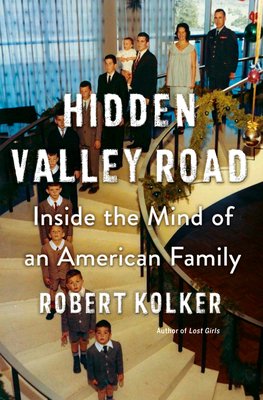
The heartrending story of a midcentury American family with twelve children, six of them diagnosed with schizophrenia, that became science’s great hope in the quest to understand the disease.

- Book Review: Hidden Valley Road: Inside the Mind of an American Family by Robert Kolker - November 17, 2026
- Review: Bees in June by Elizabeth Bass Parman - September 26, 2025
- Book Review: Welcome to the Hyunam-Dong Bookshop by Hwang Bo-Reum - May 21, 2025